| Where | When | Role |
| Mostazafan Foundation; Sina Institute | 2013-2015 | Head of the project |
The macro project of Mostazafan Foundation Business School consisted of two main components. The first included operational educational projects, and the second focused on designing the Foundation’s Business School as one of the country’s key applied and operational educational institutions.
The first component comprised three specific initiatives, for which Sina Institute and I were responsible for some the processes: a. Designing and conducting various management courses; b. Collaborating with reputable domestic and international universities, such as the University of Tehran, Würzburg University in Germany, and a Swedish university, to train selected managers and experts of the Foundation; c. Collaborating with the Ministry of Science regarding doctoral scholarships in various fields (these individuals were expected to eventually work in the Foundation’s research institutes, Business School, or operational units).
The second component began with the research project titled “Designing the Foundation’s Business School” in 2013. The project was structured into three sections: executive research consultant, external supervisor, and overall guidance and supervision by the institute (my role).
The objectives of this research project were as follows:
- Design a macro model of the Business School for Mostazafan Foundation.
- Study and understand business schools and examine their characteristics in key regions of the world.
- Review and study successful educational methods and approaches in leading business schools worldwide.
- Examine and understand the nature of business schools in Iran and their development trajectory.
- Identify and study the status (strengths and weaknesses) of the potential and existing business environment in Iran concerning business schools.
- Review and study the nature and methods of education in large organizations.
- Conduct comparative studies on the approaches of large organizations in establishing business schools.
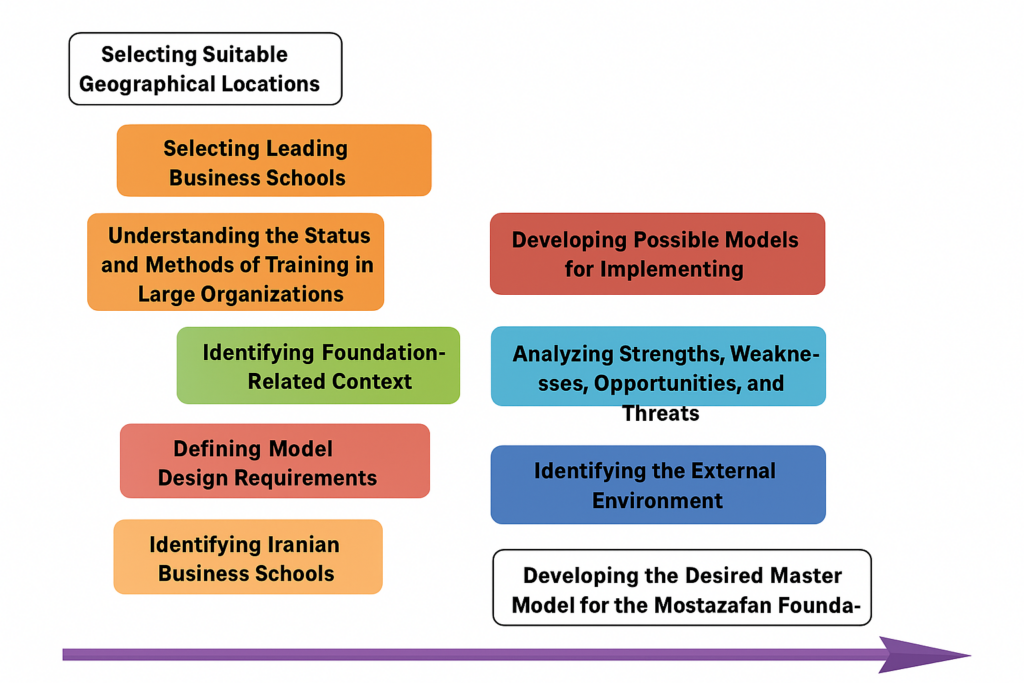
During the research, five specific reports were fully prepared:
a. Report on understanding business schools and their characteristics worldwide: included explaining the philosophy of these schools, introduction of MBA and DBA programs, and a brief analysis of 54 universities and business schools globally.
b. Report on reviewing and studying successful educational methods and approaches in leading business schools worldwide: included examination and study of 18 reputable and successful universities and business schools regarding their soft and hard resources, core objectives and missions, organizational and educational structures and processes, course content and quality, related visuals for each center, and expert evaluations. The 18 universities examined in this report were: [list could be inserted].
| University of Chicago – Booth School of Business | University of Cambridge – Judge Business School | Melbourne Business School – University of Melbourne (Australia) |
| Tuck School of Business – Dartmouth College | Strathclyde Business School | Indian Institute of Management (India) |
| Harvard Business School | Bocconi School of Management (Italy) | Nanyang Business School – Nanyang Technological University (Singapore) |
| HEC Paris | Grenoble Graduate School of Business (France) | International University of Japan – Graduate School of International Management |
| London Business School | Vlerick Business School (Belgium) | Yonsei Business School (Korea) |
| ESMT Berlin – European School of Management and Technology (Germany) | The University of Hong Kong – Faculty of Business and Economics | NUS Business School – National University of Singapore |
c. Report on understanding the nature of business schools in Iran from inception to present: included explaining the history of business management programs in Iran, introducing and explaining the main aspects of universities and educational centers offering these programs, presenting findings from studies and field interviews with experts in the country, and identifying strengths and weaknesses, opportunities, and threats in this domain.
d. Report on external environment analysis: included developing a framework for studying the external environment at national, industry, and market levels, analyzing national environmental factors in four dimensions—political and legal, economic and financial, socio-cultural, and technological (educational methods and technologies), analyzing the industry environment (Ministry of Science level and existing business schools), and specifically examining e-learning as an emerging and significant approach in education that could profoundly affect the industry’s future.
e. Report on studying the nature and methods of education in large organizations: included explaining the concept of organizational learning, methods to improve organizational learning effectiveness, organizational universities and their dimensions, possible approaches and structures in such entities, and presenting results from studies of nine domestic and international organizational training centers, such as Motorola University, Disney, Trump, and Shahid Abbaspour Oil and Water & Power Training Centers.
It should be noted that structural upstream limitations and changes in the Foundation’s leadership hindered the progress of other phases of the first component and the executive actions of the second component. Consequently, the initially defined objectives of this project were almost entirely set aside during the new leadership period.